
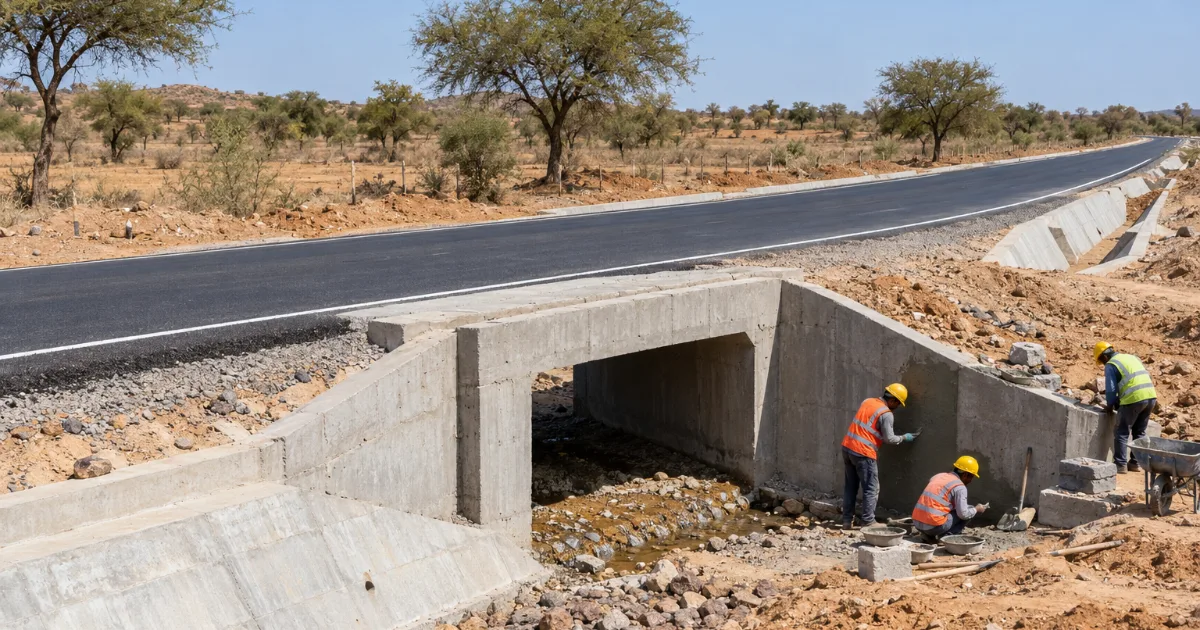
Ask any experienced road engineer what destroys roads fastest and the answer is usually the same: water. A road may have a good base and a well-laid surface, but if rainwater stands on it or soaks into the layers below, potholes, edge breaks and settlement follow quickly. In Rajasthan, where rainfall is short but often intense, good drainage is what separates a road that lasts from one that needs repair after the first monsoon.
1. How water damages a road
Water enters the road from the top through cracks, from the sides when drains are blocked, and from below when the ground water rises. Once the granular base or subgrade becomes wet, it loses strength. Heavy vehicles then push the weakened layers out of shape, and the surface cracks and breaks.
2. Camber and surface drainage
The first line of defence is the shape of the road itself. A correct camber (cross slope) sends rain to the edges instead of letting it pond in the middle. Shoulders must be compacted and sloped away from the pavement edge so that water does not seep under the road.
- Check camber with a template during construction, not only at the end.
- Avoid low points on the road surface where water can collect.
- Keep shoulders level with or slightly below the pavement edge.
3. Side drains
Side drains collect water from the road and carry it to a safe outfall. In built-up areas they are usually lined with masonry or concrete; on rural roads they may be unlined trapezoidal drains. What matters most is a continuous slope and a proper outlet, so that the drain empties instead of becoming a long pond next to the road.
4. Culverts and cross-drainage works
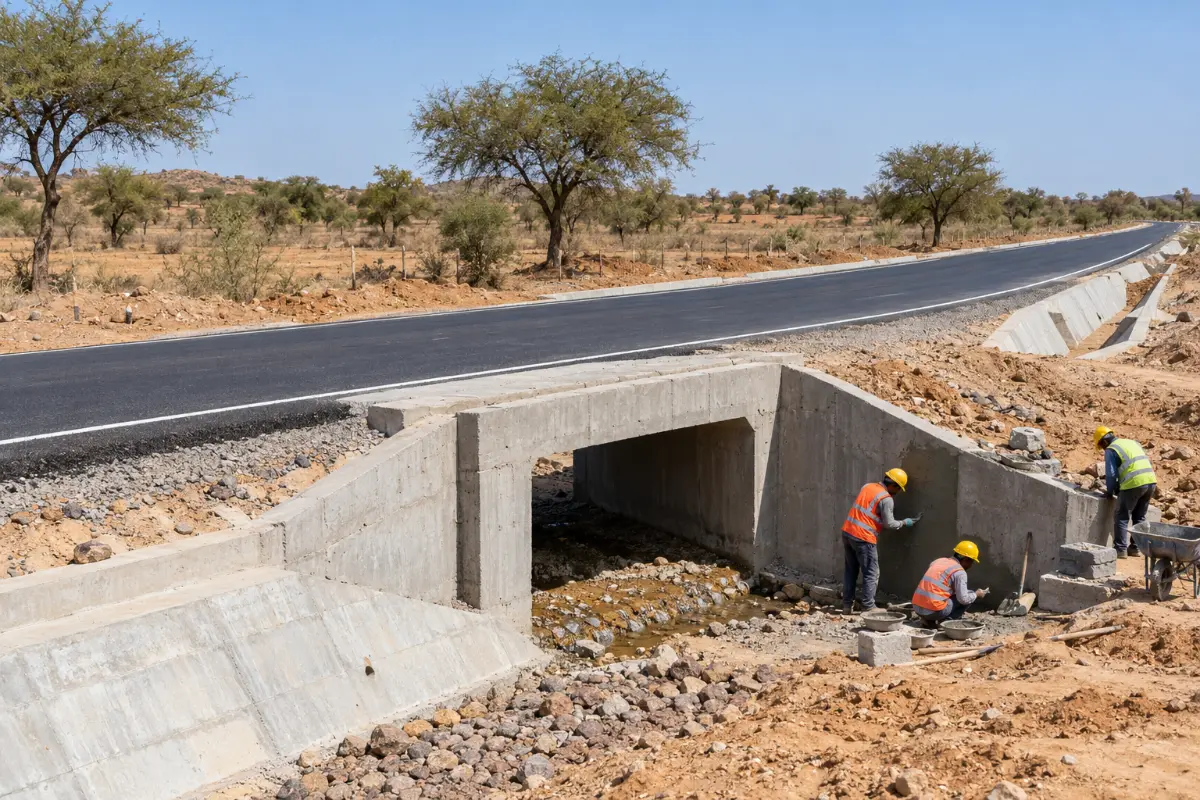
Wherever a natural stream, nala or field channel crosses the road, a cross-drainage structure is needed. Common types are:
- Pipe culverts for small flows, with proper bedding and headwalls.
- Box culverts for larger flows and where the road level is close to the stream bed.
- Slab culverts and small bridges where the opening must be wider.
- Causeways on low-traffic rural roads where occasional overtopping is acceptable.
The size and type depend on the catchment area, expected flood flow and site conditions, so they should be designed by a qualified engineer using the applicable IRC guidelines rather than chosen by eye on site.
5. Subsurface drainage
In waterlogged or irrigated areas, a raised embankment, a drainage layer of granular material or a filter drain may be needed to keep the subgrade dry. These details are much cheaper to build at the start than to add after the road fails.
6. Maintenance after construction
Even a well-designed system fails if it is not maintained. Before every monsoon, clear silt, plastic and vegetation from drains and culvert openings, repair damaged headwalls and fill eroded shoulders. A short inspection after the first heavy rain shows where water is not flowing as planned.
Drainage is planned together with the pavement itself, as explained in our bituminous road construction process and the guide on choosing a road construction contractor in Rajasthan. The right machinery also helps achieve the correct levels and compaction.
Rural road and drainage works often go hand in hand with farm-level projects such as solar irrigation pumps; the ATTPL Solar agriculture solar page explains how those pumps are installed.
7. Common drainage mistakes to avoid
- Building the road level lower than the surrounding fields, so water flows onto the road instead of away from it.
- Ending side drains without an outfall, which turns them into stagnant ponds.
- Using undersized pipes because they are cheaper or easier to source.
- Leaving culvert inlets and outlets unprotected, so scour undermines the structure in the first flood.
- Allowing roadside construction or encroachment to block drains after the project is handed over.
A drainage plan drawn at the design stage, checked during construction and handed over with a simple maintenance schedule avoids most of these problems and protects the investment made in the road.
Frequently asked questions
Why do new roads break after the first monsoon?
The most common reasons are poor camber, blocked or missing side drains and inadequate culverts, which let water soak into the base and subgrade. Weak compaction makes the damage worse.
Who decides the size of a culvert?
A qualified highway or hydraulic engineer should size culverts based on catchment area, flood flow and site levels, following the relevant IRC guidelines.
How often should road drains be cleaned?
At least once before every monsoon and again after heavy storms, plus whenever inspections show silt or debris blocking the flow.
Building or upgrading a road in Rajasthan? Talk to ATTPL Infra about road, drainage and culvert works.